 Ultimate guide
Biologically Complete Compost Testing: A Complete Guide
Quick Summary
Biologically complete compost testing checks whether compost holds a living, diverse microbial community alongside its nutrient content. Standard nutrient tests report chemistry, while biological tests report life. Pathogen screening, stability indicators and microbial measures together show whether the compost is safe and ready for plants.
- Standard nutrient tests measure total nitrogen, phosphorus, potassium, pH and organic matter but not nutrient availability.
- Pathogen screening for Salmonella and E. coli matters most for compost used on food crops.
- Collect samples from at least five to ten spots across the pile, at several depths.
- Read results in order: pathogens first, then stability, then biology, then match to the intended use.
- Retest after any failed test, typically one to two weeks after correcting activity issues.
Table of Contents
- Biologically Complete Compost Testing: A Complete Guide
- What Biologically Complete Compost Means
- Standard Nutrient Testing vs. Biological Testing
- What Biological Tests Measure: Microbes, Pathogens, and Activity
- How to Collect a Representative Compost Sample
- Compost Maturity Test Methods and Stability Indicators
- Reading Your Compost Test Results
- DIY Testing vs. Professional Lab Analysis
- Troubleshooting Failed Tests and Seasonal Testing Frequency
- Ordering Your First Biological Test With BioSys
- Frequently Asked Questions
Biologically Complete Compost Testing: A Complete Guide
Last Updated: November 19, 2026
What Biologically Complete Compost Means
Biologically complete compost testing measures whether a compost contains a living, diverse community of microorganisms in the proportions a healthy soil needs, rather than only checking its nutrient content. Growers often focus on NPK numbers while ignoring the biology that actually drives nutrient release, which is why this distinction matters.
Biologically complete compost is compost that has finished decomposing, is free of harmful pathogens, and contains an active, diverse microbial community. Standard compost tests report chemistry. Biological tests report life.
The Soil Food Web and Why It Matters
The soil food web is the network of bacteria, fungi, protozoa, nematodes, and arthropods that cycle nutrients through the soil. Bacteria and fungi break down organic matter, protozoa and nematodes eat those microbes and release nitrogen in plant-available forms, and the cycle repeats.
When any link in this chain is missing, nutrients stay locked up. A compost that is chemically rich but biologically depleted can leave plants hungry. That is the core reason biological testing exists alongside nutrient testing.
Standard Nutrient Testing vs. Biological Testing
Standard nutrient testing measures total nitrogen, phosphorus, potassium, pH, and organic matter. It answers how much of each nutrient is present. It does not tell you whether those nutrients will become available to plants.
Biological testing answers a different question: is the material alive and functioning? A lab typically measures microbial biomass, the fungal-to-bacterial ratio, respiration rate, and the presence or absence of pathogens. Chemistry tells you the potential, and biology tells you whether that potential gets delivered.
What Biological Tests Measure: Microbes, Pathogens, and Activity
A biological compost report usually covers three categories: the diversity and density of microbes, screening for human pathogens, and indicators of metabolic activity. Each one tells you something different about readiness and safety.
Microbial Diversity and Population Density
Population density shows how many organisms are present, often reported as colony forming units or as microbial biomass. Diversity shows how many types are present. A high count of a single organism is less useful than a broad mix, because different microbes perform different functions in nutrient cycling.
The fungal-to-bacterial ratio is one of the most watched numbers. Perennial crops and woody plants generally favor fungal-dominated soils, while annual vegetable systems often run more bacterial. Read this ratio against your crop, not against a single universal target.
Pathogen Screening for Salmonella and E. coli
Pathogen screening checks for organisms such as Salmonella and E. coli, along with fecal coliform indicators. This matters most for compost used on food crops. Under the U.S. Department of Agriculture's National Organic Program, compost used in certified organic production must meet specific pathogen and handling requirements, and a documented test is the most reliable way to show compliance (USDA National Organic Program compost standards).
How to Collect a Representative Compost Sample
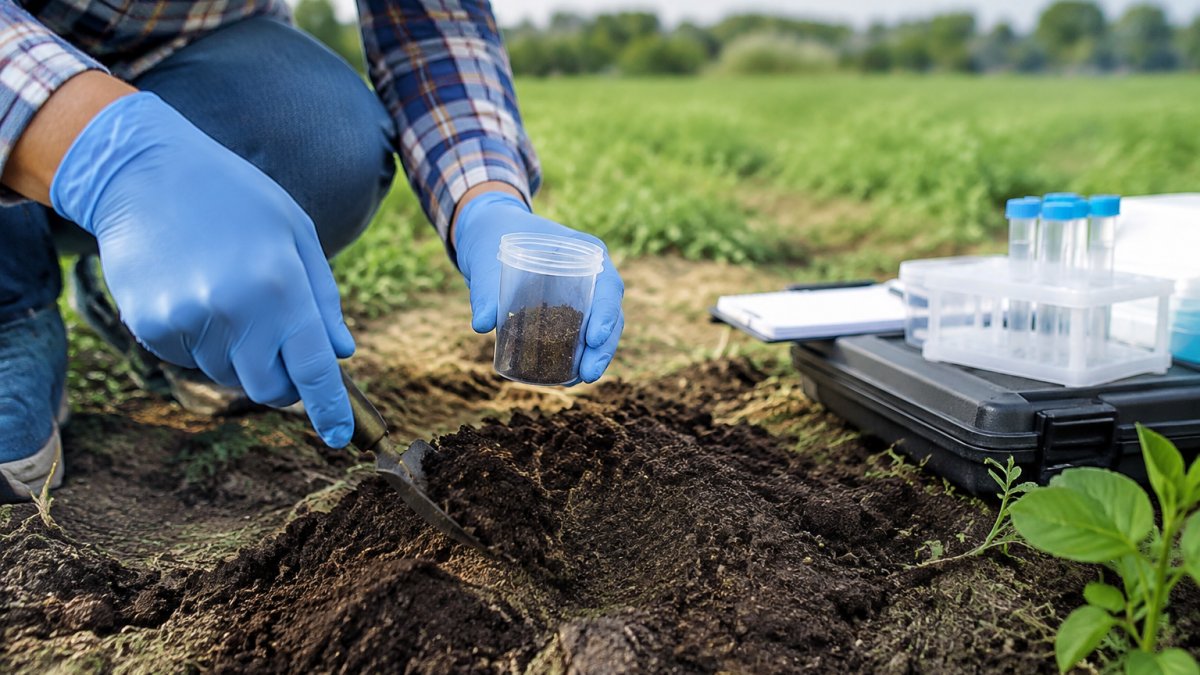
A test is only as good as the sample behind it. Collect material from at least five to ten spots across the pile, at several depths, then combine them into one clean container. Avoid the outer crust, which is often drier and cooler than the interior and will not represent the batch.
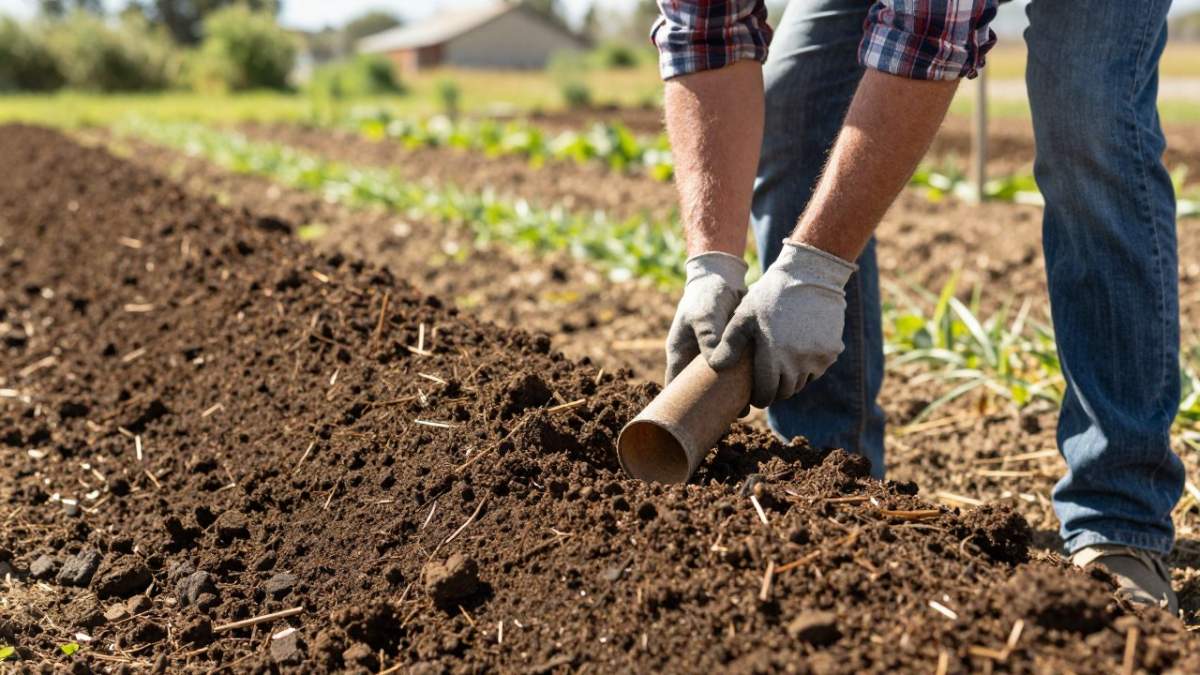
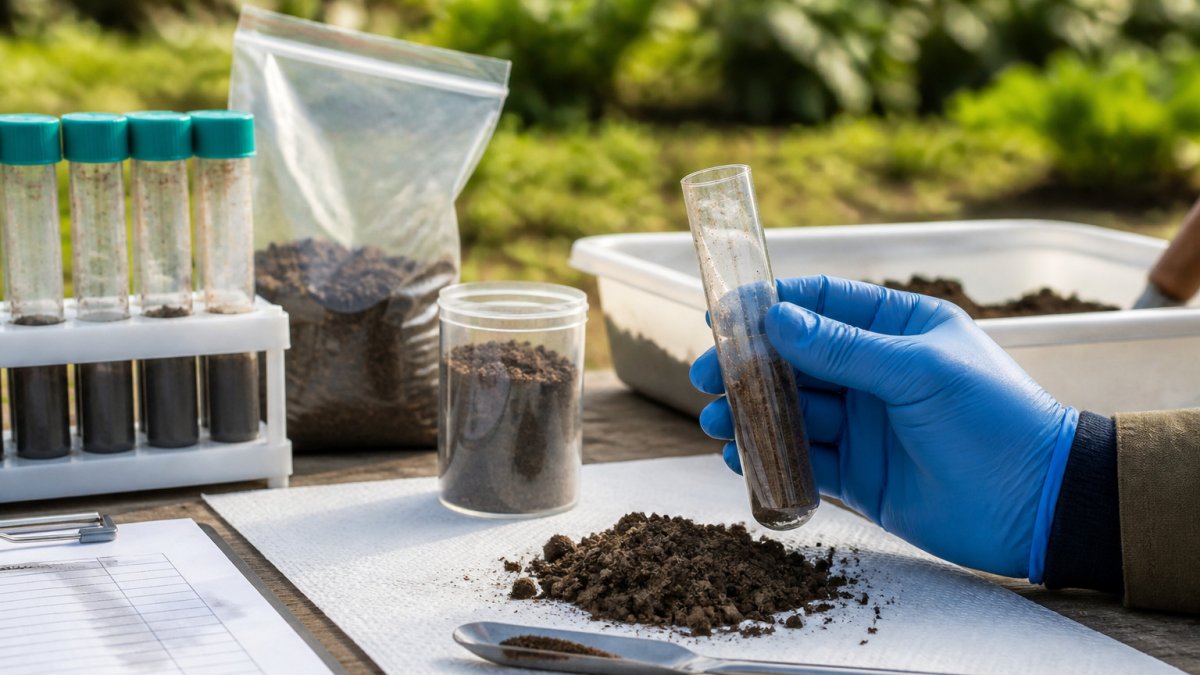
Use clean tools, keep the sample cool, and ship it to the lab promptly. Label each sample clearly and record the date, the source, and the intended use.
!A farmer's gloved hands pushing a sampling tube into a windrow of dark, crumbly compost on a sunny farm yard
Compost Maturity Test Methods and Stability Indicators
Maturity and stability are related but not identical. Stability describes how much decomposition is still happening. Maturity describes whether the compost is safe and beneficial for plants. A compost can be stable yet still contain phytotoxic compounds, so both need checking.
Common indicators include respiration rate, which measures how fast microbes are consuming oxygen, and a germination or bioassay test, which checks whether seeds grow normally in the material. Respiration is a stability signal, while a healthy germination result is evidence of maturity.
Reading Your Compost Test Results
A biological compost report is not a pass/fail scorecard. It is a set of signals that only mean something when read in a fixed order and against your intended use. Read the report in a fixed order instead of scanning for the biggest number first.
Step 1: Clear the safety gate first
Start with the pathogen screen. Salmonella, E. coli, and fecal coliform results override every other number on the report. If any pathogen result fails, the compost is not ready for food-crop use regardless of how strong its biology looks, and the fix is a process fix (more time at temperature, better turning), not a biological amendment. Under the USDA National Organic Program, compost used in certified organic production must meet specific pathogen and handling requirements, and a documented lab result is the most reliable way to demonstrate compliance (USDA National Organic Program compost standards).
Step 2: Confirm the compost has finished decomposing
Next, read the stability indicators, respiration rate and, where reported, the carbon-to-nitrogen ratio. Respiration measures how fast microbes are consuming oxygen; a high rate means the pile is still actively decomposing and will compete with plants for nitrogen if applied now. A respiration reading that looks 'active' when a grower expected 'finished' can signal that the pile needs to cure longer before use.
Step 3: Judge biological function, not just counts
Only after safety and stability are cleared should you read microbial biomass, diversity, and the fungal-to-bacterial ratio. Population density (often reported as colony forming units or as microbial biomass) tells you how much life is present. Diversity tells you how many functional groups are represented. A high count of a single organism is far less useful than a broad mix, because different microbes perform different jobs in nutrient cycling.
Read the fungal-to-bacterial ratio against your crop, not against a single universal target. Perennial crops and woody plants generally favor fungal-dominated soils, while annual vegetable systems often run more bacterial. A ratio that is 'wrong' for one crop can be 'right' for another.
Step 4: Match the profile to the intended use
Compare the full report against where the compost is going. Compost for a seedling mix needs to be mature, low in salts, and low in residual respiration. Compost for a pasture or orchard can tolerate a looser profile and may even benefit from higher fungal presence. The same report can be excellent for one use and marginal for another.
A practical reading order
- Pathogens: fail here and nothing else matters.
- Stability (respiration, C:N): confirms the pile is finished.
- Biology (biomass, diversity, F:B ratio): confirms the material is alive and functioning.
- Use match: confirms the profile fits the crop and application.
Watch out: treating any single number as a verdict. A low biomass reading on an otherwise stable, pathogen-clean compost is one data point, not a disqualification, ask the lab for interpretation guidance and retest before making a large application decision.
The table below summarises the four-step reading order the article recommends for interpreting a biological compost report.
| Step | What to check | Why it comes here |
|---|---|---|
| 1. Safety gate | Salmonella, E. coli, fecal coliform | Failure overrides every other number |
| 2. Stability | Respiration rate, C:N ratio | Confirms the pile has finished decomposing |
| 3. Biology | Biomass, diversity, F:B ratio | Confirms material is alive and functioning |
| 4. Use match | Profile versus crop and application | Same report can suit one use and not another |
DIY Testing vs. Professional Lab Analysis
Home test kits are inexpensive and useful for spot checks, such as pH, moisture, or a basic smell and temperature assessment. They cannot reliably detect pathogens or measure microbial biomass.
Professional lab analysis costs more but produces results you can document and act on. For certified organic operations, commercial sales, or any food-crop use, lab analysis is the practical choice. Many growers use DIY checks between lab tests to track trends.
- DIY kits: Low cost, quick, useful for trends, no pathogen data
- Professional labs: Higher cost, documented, includes pathogens and biology
- Best practice: Lab test at key points, DIY checks in between
Troubleshooting Failed Tests and Seasonal Testing Frequency
Most guides stop at 'retest after correcting the cause.' That leaves growers holding a failed report with no clear path forward. This section walks through the common failure patterns, what each one actually means biologically, and how to re-activate a pile that has gone quiet, a gap none of the mainstream resources address.
Pattern 1: Low microbial activity (a 'quiet' pile)
A low biomass or low respiration reading on a compost that should be finished usually points to one of three mechanisms:
- Carbon-to-nitrogen imbalance. Too much carbon relative to nitrogen stalls microbial growth because microbes lack the nitrogen to build protein. The fix is to blend in a nitrogen-rich feedstock and turn the pile to restart the cycle.
- Excess moisture. Saturated pore spaces displace oxygen, and aerobic microbes, the ones you want, suffocate. Squeeze a handful: if water runs out, the pile is too wet. Turn it, add dry carbon, and let it breathe.
- Compaction. A dense, unturned pile develops anaerobic pockets. Turning reintroduces oxygen and redistributes the microbial community.
To re-activate a quiet pile, correct the underlying imbalance first, then turn and monitor temperature and moisture for one to two weeks before retesting. Adding a commercial inoculum before fixing the cause rarely works, because the introduced organisms face the same conditions that stalled the original community.
Pattern 2: Failed pathogen screen
Elevated Salmonella or E. coli almost always means the pile did not sustain sufficient temperature long enough, or that recontamination occurred after the heating phase. The corrective action is process, not product: turn and reheat the pile to reach and hold the target temperature throughout the mass, then retest before any food-crop use. Recontamination from dirty equipment, birds, or runoff can undo a successful heating phase, so clean tools and cover the pile.
Pattern 3: Poor maturity (failed germination or bioassay)
A failed germination test signals phytotoxic compounds, often organic acids from incomplete decomposition, still present. The fix is more curing time with periodic turning, not a biological amendment. Retest only after the pile has had time to finish.
Pattern 4: Wrong biology for the crop
A fungal-to-bacterial ratio that does not match the intended crop is not a 'failed' test, it is a mismatch. Correct it by adjusting feedstock and management over the next cycle, or by blending composts with complementary profiles before application.
How often to test
Testing frequency should follow the production cycle and the intended use, not a fixed calendar:
- Each new batch: test before it leaves the operation, especially for commercial sale or food-crop use.
- Start and end of the main growing season: gives a useful trend line for a soil program.
- After any feedstock change: a new input can shift the biology, so retest rather than assume.
- After a failed test and correction: retest once the corrective action has had time to work, typically one to two weeks for activity issues, longer for maturity issues.
A practical pattern many growers use is a full lab panel at batch completion and at season boundaries, with inexpensive DIY checks (temperature, moisture, smell) in between to catch drift early.
Ordering Your First Biological Test With BioSys
If you are testing compost for the first time, start with a sample that represents your typical batch, and tell the lab how you plan to use it. That context changes which tests matter most.
BioSys offers soil biology testing and biologically complete, custom-fit compost production. Pricing depends on the test package, quantity, and delivery, so contact BioSys directly for a current quote.
Frequently Asked Questions
What does a biological compost test measure?
A biological compost test looks at the living part of the material rather than only its nutrient content. Labs typically report microbial biomass, the balance of fungi to bacteria, the presence of beneficial organisms such as protozoa and nematodes, and respiration rate, which shows how active the microbial community is. Many tests also screen for pathogens such as Salmonella and E. coli. Together these results show whether the compost can support a functioning soil food web, which a standard nutrient panel cannot show on its own.
How do I test for nutrients in compost?
Nutrient testing is the standard panel most extension labs offer. You submit a representative sample, and the lab reports total nitrogen, phosphorus, potassium, pH, electrical conductivity, and the carbon-to-nitrogen ratio, along with organic matter content. Nutrient results tell you how much fertilizer value the compost provides, but they do not tell you whether the microbes that make those nutrients available are present. For a full picture, pair a nutrient panel with a biological test.
How can you tell whether compost is mature and ready to use?
Maturity is usually judged by stability and phytotoxicity. Stability means the material has finished decomposing and will not heat up or consume oxygen rapidly when stored or applied. Maturity testing commonly includes a respiration test and a seed germination bioassay to check for compounds that inhibit plant growth. Visually, mature compost is dark, earthy-smelling, and no longer shows recognizable feedstock. A lab test confirms what the eye cannot.
How often should compost be tested?
Test each batch you intend to sell or apply at scale, and retest when feedstock, process, or season changes. Many producers test at the end of the active phase and again before release. Home gardeners rarely need repeated lab tests, but a single biological test on a new source of compost can establish a useful baseline. Seasonal testing is most useful when you are comparing batches made under different weather conditions.
What is the difference between a compost nutrient test and a biological test?
A nutrient test measures chemical content: how much nitrogen, phosphorus, and potassium the material holds and what its pH is. A biological test measures living activity: how many microbes are present, how diverse they are, how active they are, and whether pathogens are present. The two answer different questions. A compost can be rich in nutrients and still biologically weak, which is why producers who sell for soil health often order both.
How do you collect a representative compost sample for a lab?
Take subsamples from at least five to ten spots across the pile, reaching a depth of about 6 to 12 inches, and avoid the outer crust. Combine them in a clean bucket, mix well, and fill the lab's container to the required volume. Keep the sample cool and out of direct sun, and ship it promptly, since microbial activity changes quickly after collection. Follow the specific instructions from your lab, because some tests require refrigerated or frozen samples.
Are biosolids safe to use in vegetable gardens?
Biosolids are regulated under EPA Part 503 rules, which set limits on pollutants and pathogens for land application. Class A biosolids meet the strictest pathogen standard and are generally considered suitable for food gardens when used as directed. Class B biosolids have more restrictions on use, including waiting periods before harvest and limits on where they can be applied. Check the product label or ask the supplier for its classification and any test results before using it on edible crops.
Can I test compost myself at home?
Simple home methods can give a rough sense of compost quality, such as smell, temperature, moisture, and the presence of earthworms. Field kits for pH or basic nutrients are also available. However, biological completeness and pathogen screening require lab equipment such as microscopes, culturing, or DNA-based assays. Use home checks for day-to-day decisions and a professional lab for batch verification, buyer assurance, or any decision with food safety implications.